Rust, Coatings, Weather, Costs, And Permits
Danville Metal Roof Coating Questions
Answers to the questions Danville owners ask about coating commercial metal roofs, from rust and screws to weather windows, costs, and permits.
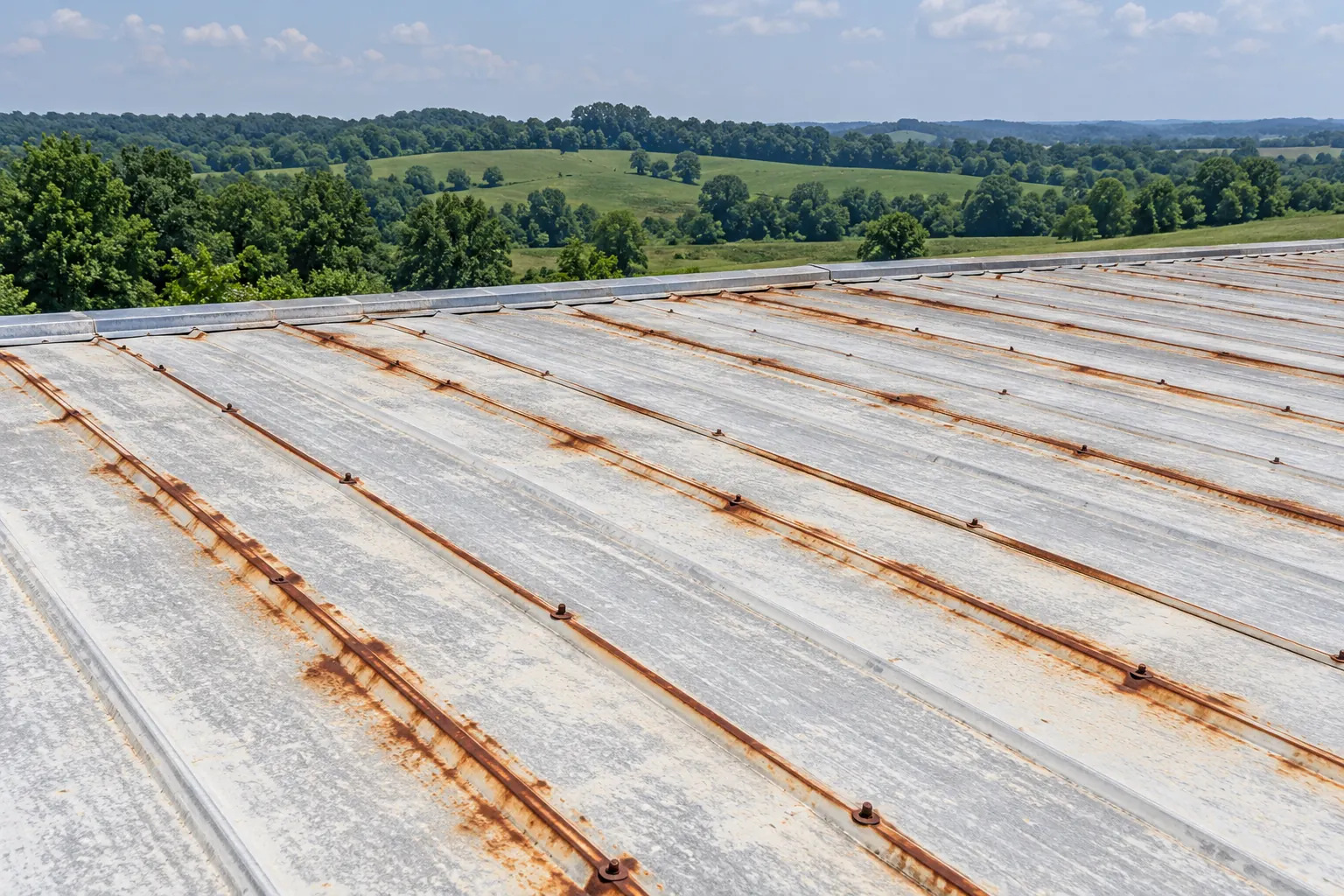
Metal roof coating is a fluid-applied membrane, rolled or sprayed over cleaned and primed metal panels, that cures into one continuous waterproof skin across seams, laps and fasteners. Danville Metal Roof Coating coats commercial metal roofs and applies silicone, acrylic, spray foam and shingle roof coatings in Danville, Boyle County, Kentucky, and nearby Harrodsburg, Stanford and Junction City.
Metal Roof Coating Basics
What does a metal roof coating do on a commercial building?
A metal roof coating seals the seams, panel laps and fastener heads of a metal roof under one flexible membrane. Most leaks on a metal building start at those small openings rather than in the middle of a panel.
The coating goes on as a liquid and cures into a rubbery film that moves with the panels as they heat and cool. On a warehouse or shop, the work includes:
- Treating rust on panels, ridge caps and gutters
- Sealing every fastener and its washer
- Reinforcing laps and seams with fabric or mastic
- Topcoating the whole field
The finished roof keeps its steel structure and gains a new weathering surface on top.
Which commercial metal roofs can be coated?
Exposed-fastener R-panel roofs and standing seam roofs can both be coated once the panels are firmly attached and the rust is treated. The difference is where the prep time goes.
Prep item Exposed-fastener R-panel Standing seam Fasteners Replace or seal every screw Clips hidden; check trim screws Laps Side laps and end laps sealed Seams sealed where opened Movement Moderate High; coating must stretch at seams Common leak points Screws, end laps, ridge caps Seam ends, penetrations, eave trim Corrugated panels on older farm and equipment buildings fit too, as long as the steel still has its thickness at the bottom of each rib. Panels rusted through or loose across wide areas get repaired first.
Will a white coating make a metal building cooler inside?
A white, highly reflective coating lowers the temperature of a sunlit metal roof, which cuts the heat passing into the building under it. The U.S. Department of Energy guide to cool roofs explains that a roof's coolness comes from two properties, solar reflectance and thermal emittance.
The change shows most in buildings with little insulation under the panels, such as shops, equipment sheds and older warehouses. A building with a thick insulation blanket feels less difference.
Rated products are listed in the Cool Roof Rating Council directory, where owners can compare reflectance and emittance figures for specific coatings. Dirt and chalking on the topcoat lower reflectance over time, so periodic washing helps.
When is a metal roof past the point of coating?
Panels that have lost their strength mark the end of coating, such as rust holes across many panels, steel that flakes away under a wire brush, or a deck that flexes underfoot. At that stage a coating would only cover failed metal.
Roof condition Best fit Surface rust, loose screws, leaking laps Coat Scattered rust-through, a few bad panels, failed trim Restore: replace those parts, then coat Wide areas of perforated or bent panels Re-panel those sections Failing purlins, structural sag, soaked insulation Replace the roof system Photos of the worst areas, a check of fastener grip and a walk along the eaves and gutters show which row a building fits.
Rust, Fasteners and Seams
How do you treat red rust before coating a metal roof?
Red rust gets removed down to firm metal and primed with a rust-inhibiting primer before any coating touches it. Coating over loose scale traps the rust and lets it keep spreading under the film.
Crews work the rust in this order:
- Wire-brush or grind flaking rust at laps, eaves and fasteners
- Pressure-wash the panels to remove dust and chalk
- Spot-prime bare and rusted areas
- Full-prime the field where rust bloom covers wide areas
Light orange staining that wipes off cleanly needs less work than red rust that lifts in flakes. The goal is a firm, clean surface the primer can grip.
What is white rust on galvanized panels, and does it matter?
White rust is the chalky zinc corrosion that forms on galvanized steel, and it has to be cleaned off before coating because primers bond poorly to it. It shows up most along panel laps, inside gutters and on north-facing slopes where moisture lingers.
Galvanized and Galvalume panels each need a primer matched to their metal finish. A crew tests adhesion with a small patch before treating the whole roof.
Painted factory finishes that have chalked heavily also need washing and sometimes an etching primer. If a finger dragged across the panel picks up white or colored powder, that chalk will block adhesion until it is washed away.
Should the screws be replaced before a metal roof is coated?
Screws with cracked, hardened or missing washers should be replaced before coating, usually with a slightly larger screw that bites into fresh metal. A backed-out screw leaves a gap at the washer that water follows into the building.
Common fastener problems on central Kentucky metal buildings include:
- Washers split from years of sun
- Screws stripped by panel movement
- Heads rusted where paint wore off
- Missing fasteners at end laps and ridge caps
After the screws are set, each head gets a dab of mastic or a sealant cap, then the coating. That two-layer treatment at every fastener is where a metal coating job earns most of its leak control.
How are panel laps, end laps and seams sealed?
Panel laps, end laps and seams get a reinforced seal of fabric embedded in base coat, or a brush-grade mastic, before the full topcoat goes on. These joints move the most as panels expand and contract, so they need more material than flat panel areas.
End laps, where one panel overlaps the next down the slope, are the most common leak point on long warehouse runs. Wind-driven rain backs up under them.
Joint Usual treatment Side lap (R-panel) Mastic or fabric strip along the lap End lap Fabric-reinforced base coat across the full width Standing seam Seam tape or mastic where the seam has opened Ridge cap and trim Mastic at closures, fabric at laps What happens to skylight panels, gutters and ridge caps during coating?
Fiberglass skylight panels are either replaced or sealed at their edges and left uncoated, since coating them would block their light. Old skylight panels often crack and yellow, so many owners swap them for new panels or cover them with metal first.
Gutters on metal buildings rust from the inside, where leaves and grit hold water against the steel. A crew cleans them, treats the rust, and coats the gutter interior when the metal still has strength.
Ridge caps get new closures or mastic where wind has lifted them, and each ridge fastener is checked. Pipe boots, curbs and wall flashing get their own sealing before the topcoat ties everything together.
Choosing a Coating
Silicone, acrylic or urethane: which coating fits a metal roof?
All three common coating types work on metal roofs, and the right pick depends on drainage, foot traffic and how the roof will be recoated later.
Factor Silicone Acrylic Urethane Water sitting in gutters or low spots Handles it well Weak where water sits Handles it well Foot traffic and impact Softer surface Moderate Toughest surface Dirt pickup Collects more dirt Stays cleaner Stays cleaner Later recoat Only silicone bonds to it Accepts acrylic or silicone Accepts several types Cure conditions Tolerates cooler, damper days Needs warm, dry weather Moderate Many metal jobs combine products, such as a urethane or acrylic base at the seams with a silicone topcoat across the field. The manufacturer's specs control what can go over what.
When does silicone roof coating make sense over metal?
Silicone roof coating makes sense on metal roofs with low pitch, long panel runs and gutters or valleys that hold water after rain. Silicone resists standing water and sunlight breakdown better than water-based acrylics.
It also cures on cooler, more humid days, which widens the working season in central Kentucky's spring and fall. Owners should weigh three trade-offs:
- Dirt sticks to the surface and lowers reflectance until rain or washing clears it
- Recoats later require silicone, since most other coatings release from cured silicone
- Foot paths to rooftop units need walk pads or extra granules
Silicone fits a large warehouse or plant roof where few people walk and drainage at the laps is slow.
When is acrylic roof coating the better choice for a metal building?
Acrylic roof coating is the better choice on steeper metal roofs that shed water quickly and where a bright, clean white surface matters. Water-based acrylics roll on easily, stay cleaner than silicone, and accept a fresh acrylic coat years later after washing and priming.
Acrylic needs warm, dry weather to cure, so application in central Kentucky is planned for late spring through early fall, with no rain or dew in the forecast for the first hours.
Its weak spot is standing water. Gutters, valleys and flat sections that stay wet for days soften acrylic over time. On those spots, a crew can run a silicone or urethane detail while the field stays acrylic.
Is spray foam over a metal roof better than a coating alone?
Spray foam over a metal roof adds insulation and builds a new surface, while a coating alone seals the existing panels without adding insulation. The choice turns on how much heat the building gains and loses through its roof now.
Point Coating only Spray foam plus coating Insulation added Reflectivity only Closed-cell foam layer Fastener and lap sealing Fabric and mastic Foam buries them Roof height change Minimal Raises edges, curbs and flashing Panel profile Ribs stay visible Ribs filled in Best for Insulated buildings with leaks Uninsulated shops, sheds and warehouses Foam needs dry panels and calm air during spraying, and it always gets a protective coating on top against sunlight.
Can asphalt shingles on a commercial building be coated?
Asphalt shingle roofs on commercial buildings such as strip centers, offices and churches can be coated when the shingles still lie flat and the shingle manufacturer allows it. Curled, cracked or granule-bare shingles need replacement instead.
Shingle roof coating is a niche option. Some shingle makers restrict coatings in their product terms, so the original documents are worth checking first.
A shingle roof that qualifies gets:
- Loose tabs sealed down
- Exposed nail heads sealed
- Flashing at walls and vents repaired
- A breathable coating made for shingles
The coated roof keeps the shingle look with a sealed, reflective surface. On a metal building with a shingled office wing, both roofs can be handled in one visit.
Central Kentucky Weather
How does central Kentucky weather affect a metal roof coating?
Central Kentucky's wet, humid climate with freezing winters puts a metal roof coating through standing moisture, freeze-thaw cycles and summer heat in the same year. The NOAA state climate summary for Kentucky puts long-term statewide precipitation near 47.7 inches a year.
That rain finds every open end lap and backed-out screw. Winter adds ice at the eaves and in gutters, where meltwater refreezes and pries at sealant.
Summer sun makes metal panels expand during the day and contract at night. A good coating stretches with that movement at laps and fasteners instead of cracking. The coating choice and the prep plan both answer to those three stresses.
When is the best time of year to coat a metal roof near Danville?
Late spring through early fall gives the most reliable coating days around Danville, with warm panels and longer dry stretches. Acrylics need that warmth, while silicone and some urethanes stretch the season into cooler spring and fall days.
Each product sheet sets a minimum air and surface temperature, plus a margin above the dew point. Metal panels cool fast after sunset and gather dew, so morning starts wait for the panels to dry and work stops early enough for the coating to skin over before evening.
Full coating on metal in winter is rare here. Repairs at leaking fasteners and laps still happen in cold months, with the full coat scheduled for spring.
Do crews watch National Weather Service forecasts before coating?
Crews check forecasts from the National Weather Service office in Louisville, which covers Danville and Boyle County, before every coating day. Hourly rain chances, dew point, humidity and wind decide whether a day works.
Wind matters on metal because overspray drifts toward parked vehicles and neighboring buildings, so windy days switch to rollers or get moved. Rain in the first hours of cure can wash uncured acrylic off the panels.
NWS Louisville has recognized Boyle County and the City of Danville as StormReady, a program built on local warning and readiness plans. Those same warnings keep crews off a metal roof when afternoon storms build.
What should owners check after a hailstorm on a coated metal roof?
After hail, owners should look for dented panels, cracked or punctured coating on rib tops, broken skylight panels and crushed gutters. Dents alone often leave a metal roof watertight, while punctures and split coating let water reach the steel.
A quick check from a ladder or roof hatch covers:
- Coating cracks along rib tops
- Skylight panels with fresh cracks
- Gutters and downspouts crushed or pulled loose
- Debris piles at downspout outlets
Dated photos help any insurance conversation. Damaged coating spots get cleaned and patched with the same product family, which keeps the roof sealed until the full surface is reviewed.
Metal Roof Coating Questions About Your Danville Building?
Call and describe what you see on the roof or inside the building. Photos of rusted laps, loose screws, and drip spots help us answer.
Have These Ready
- Roof size, if known
- Photos of problem spots
- Leak locations inside
- Building age
Or dial (859) 204-8078
Prep, Application and Downtime
What are the steps in a metal roof coating job?
A metal roof coating job runs in a set order: inspect, clean, repair, prime, detail and topcoat. A skipped step at the start shows up later as peeling or leaks.
- Inspect your roof: walk every panel, lap, fastener row, gutter and curb
- Clean: pressure-wash dirt, chalk and loose rust
- Repair: replace screws, bad panels, skylight panels and closures
- Prime: treat rust and match primer to bare, galvanized or painted metal
- Detail: seal laps, seams, fasteners, curbs and flashing
- Topcoat: roll or spray the field to the specified thickness
A wet film gauge checks thickness as crews go, since thin spots wear through first.
Can the building stay open while the roof is coated?
Most commercial buildings stay open during metal roof coating, since the work happens on top of the panels and the roof stays closed. Plants, shops and stores keep running while crews work above.
A few items need planning:
- Rooftop air intakes get shut off or covered during spraying and priming
- Parking near the eaves moves to avoid overspray
- Loading doors under the work area get a schedule
- Skylight areas get covered inside when panels are being replaced
Pressure washing makes noise and sends water off the eaves, so crews plan it around shift changes or busy store hours. Primer odors stay outside on most buildings once intakes are managed.
How long does a fresh coating need before rain?
Each coating has a rain-safe window on its product sheet, and crews time application so that window clears before any forecast rain. Silicone and some urethanes resist light rain sooner than water-based acrylics.
Full cure takes longer than rain resistance. Foot traffic on fresh coating can mark or tear it, so walkways and paths to rooftop units stay closed until the coating firms up.
On metal roofs, dew counts like rain. Panels sweat in the evening, so coating stops early enough in the afternoon for the surface to skin over before dew forms along the ribs and laps.
Does a metal roof need to be pressure washed before coating?
Every metal roof gets pressure washed before coating, because dirt, chalk, pollen and loose rust stop primers and coatings from bonding. Farm and equipment buildings often carry dust, bird droppings and exhaust residue on their panels.
Washing also exposes hidden problems, such as pinholes, thin spots in the metal and cracked sealant at laps.
Surface Wash step Painted panels with chalk Detergent wash, rinse until water runs clear Galvanized panels with white rust Wash plus scrubbing at laps Oily areas near exhaust vents Degreaser before the rinse Mildewed north slopes Mildew wash and rinse Panels dry fully before primer goes on, which on cool days can push priming to the next morning.
Cost, Value and Taxes
What drives the cost of coating a commercial metal roof?
Roof size, rust level, fastener count and detail work drive most of the cost of a metal roof coating. Two roofs of the same square footage can differ widely because of what sits on them.
Main cost drivers:
- Square footage and slope
- Amount of red rust needing grinding and primer
- Number of screws to replace or seal
- Skylight panels, curbs, vents and penetrations
- Gutter condition and trim repairs
- Coating type and specified thickness
- Access for lifts and equipment around the building
Warehouses with long, simple panel runs cost less per square foot than small shops crowded with curbs and trim pieces.
Is coating a metal roof worth it compared with replacing it?
Coating is worth it when the metal panels and structure still have life and the problems sit at seams, laps, fasteners and surface rust. Replacement tears off steel that still works, adds disposal, and opens the building to weather during the job.
Coating keeps the existing roof in place, so the building stays closed and running. The gap between the two grows on large roofs, where tear-off labor adds up fast.
Replacement wins when panels are rusted through across wide areas or the purlins and insulation have failed. A roof walk with photos of the worst panels, laps and gutters settles which path makes sense for a given building.
Does a commercial roof coating qualify for Section 179?
Improvements to the roof of an existing nonresidential building can qualify for the Section 179 deduction, since IRS Publication 946 names roofs among qualified improvements to nonresidential real property. For tax years beginning in 2026, the limit is $2,560,000, reduced once qualifying property placed in service tops $4,090,000.
Roofs on residential rental property are excluded. Whether a coating counts as a capital improvement or a repair expense is a question for a CPA, who will look at the full scope of work. A restoration with new screws, primers and topcoat on a plant or warehouse reads differently than a few patched laps.
Keep invoices and photos that show the work done on the roof.
Are there utility rebates for coating a metal roof in the Danville area?
Business efficiency programs exist in the Danville area, but roof coating eligibility varies by provider and changes over time, so check with the utility on your bill before work starts. Count on a rebate only after the utility confirms it in writing.
Inter-County Energy, a member-owned cooperative headquartered in Danville, serves much of the area. Kentucky Utilities serves many central Kentucky businesses, and LG&E and KU list business rebates online.
Bring the utility:
- Roof square footage
- The coating product name and its rated reflectance
- Insulation level under the panels
- A year of past power bills
Permits and Building Codes
Who issues commercial roofing permits around Danville?
Commercial building permits around Danville come from the county building office where the building sits, with the Kentucky Department of Housing, Buildings and Construction (HBC) assigning a state building inspector to each county.
Town County Local office State contact Danville Boyle Boyle County Building Inspection HBC sheet for Boyle County Junction City Boyle Boyle County Building Inspection; confirm any city filing HBC sheet for Boyle County Harrodsburg Mercer Mercer County Building Inspection, plus a city business license HBC sheet for Mercer County Stanford Lincoln Lincoln County building inspector, plus a City of Stanford permit application HBC sheet for Lincoln County Each HBC sheet lists a local building inspector and a state building inspector for the county. Call the local office first, because permit needs for coating work vary from office to office.
Does a metal roof coating need a building permit?
Whether a metal roof coating needs a building permit is the county building inspector's call, so ask before work starts. Offices often treat replacing panels, adding insulation or raising the roof differently from a straight recoat.
Spray foam over metal raises the roof edge and changes flashing heights, which makes a permit and inspection more likely. Re-paneling sections also counts as roof work in most offices.
Bring these to the conversation:
- A roof sketch with dimensions
- Coating or foam product data sheets
- Photos of eaves, ridges, curbs and skylight panels
- Notes on any panels or trim being replaced
What building code limits apply when re-covering a metal roof?
The building code limits re-covering a roof that is wet or already carries layers, and the inspector checks those conditions when a new layer such as spray foam goes over metal panels. A coating adds film, while foam adds a full new layer.
Inspectors look at:
- Wet insulation under the panels
- Rusted-through areas of the roof
- Edge metal and flashing heights after foam
- Fire separations between attached units
Core cuts and photos answer most questions early. Land use is a separate stop. For rooftop changes visible from the street or new equipment on the roof, the Danville-Boyle County Planning and Zoning office handles zoning apart from the building permit.
Questions by Town
Can large plant and warehouse roofs in Danville be coated without shutting down?
Large metal roofs on Danville manufacturing plants and warehouses are coated in zones, so production underneath keeps running. Crews divide the roof by expansion joints, roof hatches or panel runs and finish each zone through topcoat before opening the next.
Plants in Danville's industrial areas add details smaller buildings lack:
- Exhaust stacks that leave residue on panels
- Rooftop units with condensate lines draining onto the metal
- Long end-lap lines across wide spans
- Safety rules for crews entering the plant grounds
Danville plants buy power from different providers, including Kentucky Utilities and Inter-County Energy, the cooperative headquartered in Danville. Plant managers can ask their provider about efficiency programs before choosing a reflective topcoat.
What do Danville owners need from zoning before adding equipment to a coated roof?
Adding rooftop equipment or changing the roof line on a Danville building involves the Danville-Boyle County Planning and Zoning office, which handles land use separately from Boyle County Building Inspection. A plain recoat keeps the building outline unchanged.
Owners planning new rooftop units, solar racks or raised parapets should settle both offices before the coating goes on. Mounting equipment after coating means cutting into fresh coating at every bracket, curb and fastener.
A sensible order for a Danville building:
- Confirm zoning for any new rooftop equipment
- Set curbs and supports
- Flash them into the metal
- Coat the whole roof, new curbs included
Boyle County's commercial permit application covers the building side.
Who handles commercial roof permits in Harrodsburg?
Harrodsburg roof work runs through Mercer County Building Inspection, which uses a separate commercial application after Planning Commission staff check setbacks and use. Plan reviews happen in the mornings and field inspections in the afternoons.
Contractors working inside Harrodsburg city limits also need a Harrodsburg business license. The HBC contact sheet for Mercer County lists both a local building inspector and a state building inspector.
For a metal coating job on a Harrodsburg shop or storefront, bring the plan reviewer:
- Photos of the eaves, ridge and gutters
- Locations of rooftop units and skylight panels
- Any panels or trim being replaced
Do flood plain rules matter for metal buildings in Harrodsburg?
Flood plain sites in Harrodsburg need state Division of Water permits before the county building permit issues, according to Mercer County Building Inspection. A coating job that also adds rooftop equipment or structure on a flood plain parcel should start that state step early.
Metal buildings on low, damp ground deserve a close look at the bottom of the roof during the walk:
- Rust bloom along the eave line
- Gutters full of silt and leaves
- Fastener rows nearest the gutter
- Base trim where the wall panels meet the slab
Mercer County power comes from Inter-County Energy, Blue Grass Energy or Salt River Electric, per East Kentucky Power Cooperative's member list.
Where does a Stanford building owner get a roofing permit?
A commercial roof inside Stanford city limits involves both the City of Stanford, which posts its own building permit application, and the Lincoln County building inspector. The HBC contact sheet for Lincoln County places that local inspector's office at the Lincoln County Health Department in Stanford, along with an assigned state building inspector.
Checking with both the city and the county before work starts keeps a coating job from stalling halfway. Bring:
- A roof plan with panel runs and skylight panels marked
- The coating product data sheet
- Photos of rusted laps and trim
For buildings outside city limits, start with the county inspector.
Which utilities serve Stanford and Lincoln County metal buildings?
Lincoln County businesses get electricity from Inter-County Energy, Jackson Energy or South Kentucky RECC, according to East Kentucky Power Cooperative's list of owner-member cooperatives. The provider named on the bill is the one to ask about business efficiency programs.
The question matters most for uninsulated metal buildings such as equipment sheds, shops and farm supply stores, where summer sun heats the panels directly. A reflective white topcoat lowers roof surface temperature on those buildings.
Farm and equipment buildings around Stanford bring their own details:
- Lean-to additions with lower pitch and slower drainage
- Open ridge vents that need to stay open for airflow
- Gutters packed with chaff and grain dust
Does Junction City use the same permit office as Danville?
Junction City sits in Boyle County, so commercial building permits come from Boyle County Building Inspection, the same office that serves Danville. Owners should also ask the City of Junction City whether it requires a business license or local filing before crews arrive.
Because both towns share one county office, a Junction City coating job follows the same commercial permit application, and the county asks for plans when the inspector requests them.
A Junction City roof sketch should show gutters, downspouts and skylight panels, plus every spot where the building meets a neighboring structure, so the inspector sees the full reach of the coating.
What metal buildings around Junction City are good coating candidates?
Metal shops, equipment sheds and farm buildings around Junction City are strong coating candidates when the panels are attached and the rust sits on the surface. Exposed-fastener buildings in rural Boyle County often have screws that have worked loose over years of heat cycling.
For efficiency questions, rural Junction City owners on co-op power deal with Inter-County Energy, the lone Boyle County cooperative on East Kentucky Power Cooperative's member list.
Building Common issue Usual fix Equipment shed Leaks at end laps Fabric-reinforced lap seal Heated shop Rust bloom inside the eaves Coat plus insulation review Hay or storage barn Missing screws, wind-lifted ridge cap New fasteners and closures
Getting Started
What should an owner have ready before a metal roof inspection?
Owners get the most from a metal roof inspection by having roof access, leak history and building drawings ready. Leak locations inside the building point crews to the laps, fasteners or skylight panels above them.
Helpful items:
- Notes or photos of where water drips inside
- Roof hatch, ladder point or lift access
- Building age and any past roof work
- Panel type, if known from drawings
- Rooftop unit locations and service schedules
Marking leak spots with tape on the floor or ceiling makes it easy to match them to the panels above.
What happens during an inspection of a commercial metal roof?
An inspection of a commercial metal roof walks every panel run to find the rust, loose fasteners, open laps and damaged trim that decide the repair and coating plan. Danville Metal Roof Coating inspects roofs across Boyle County and in nearby Harrodsburg, Stanford and Junction City.
On the roof, the crew:
- Counts and samples fasteners for failed washers
- Checks end laps and side laps for gaps
- Tests rust depth with a wire brush or scraper
- Looks at skylight panels, curbs, gutters and ridge caps
- Photographs problem areas
The owner then gets photos and a clear explanation of whether the roof fits coating, restoration with repairs, spray foam, or replacement.
Sources
- Boyle County Building Inspection: Building Permit
- Kentucky HBC contact sheet: Boyle County
- Kentucky HBC contact sheet: Mercer County
- Kentucky HBC contact sheet: Lincoln County
- Mercer County Building Inspection
- City of Stanford Building Permit Application
- East Kentucky Power Cooperative: Owner-Member Cooperatives
- LG&E and KU Business Rebates
- NWS Louisville: Boyle County and Danville StormReady
- NOAA NCICS State Climate Summary: Kentucky
- U.S. DOE Guide to Cool Roofs
- Cool Roof Rating Council Rated Roof Products Directory
- IRS Publication 946, How To Depreciate Property
Ready For A Number On Your Roof?
Request a free ballpark estimate, or call to talk through the rust, screws, and laps on your building.